Two YouTube creators can have similar views, engagement rates and audience demographics, yet produce completely different sponsorship results.
One reason may be something most influencer dashboards struggle to measure:
Trust.
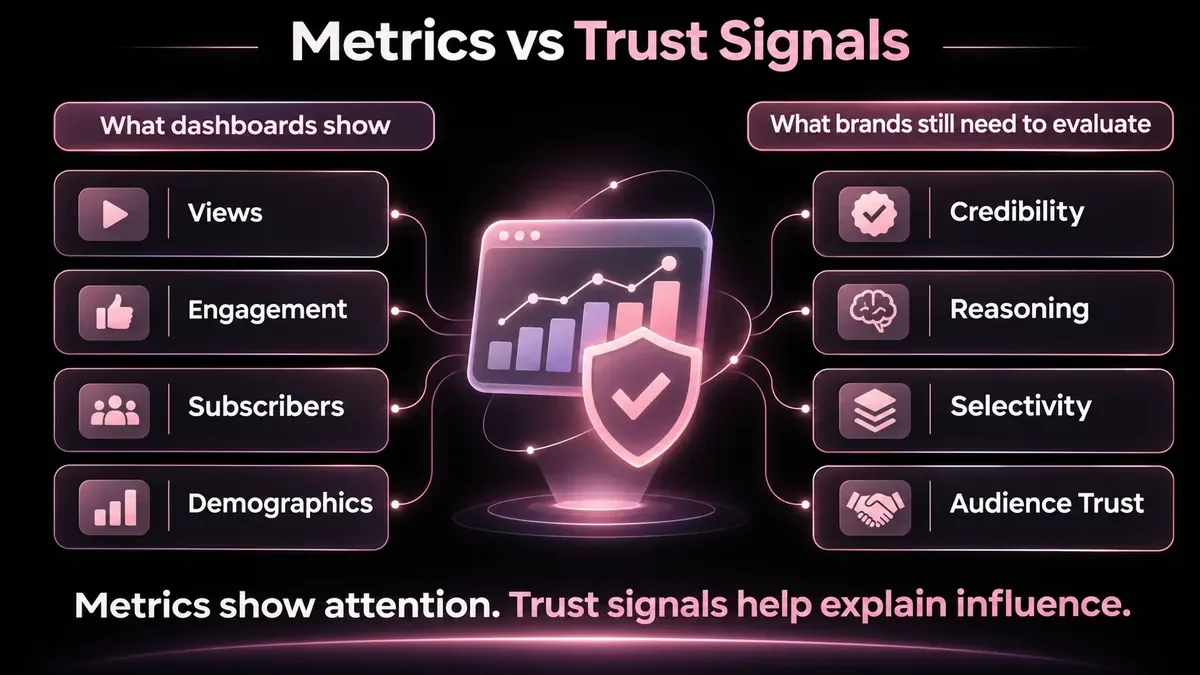
Views tell you how many people watched. Engagement tells you whether people reacted. Neither automatically tells you whether viewers actually believe the creator's recommendations.
For brands choosing creators, that distinction matters.
Recent research supports this. A 2026 meta-analysis covering 50 studies found positive relationships between influencer credibility, expertise, trustworthiness and purchase intention. Trustworthiness itself showed a meaningful positive association with purchase intention.
Engagement Is Not the Same as Trust
A highly engaged audience can still be an entertainment-first audience.
People may comment because a creator is funny, controversial or good at generating discussion.
That does not necessarily mean those same viewers will trust the creator when they recommend a password manager, laptop, VPN or AI tool.
Research has found an important distinction between engagement and credibility. One recent meta-analysis found that credibility was particularly important for purchase intention, while attractiveness was more closely linked to engagement.
That means a brand should be careful about assuming:
High engagement = strong sponsorship influence
It may.
But it is not guaranteed.
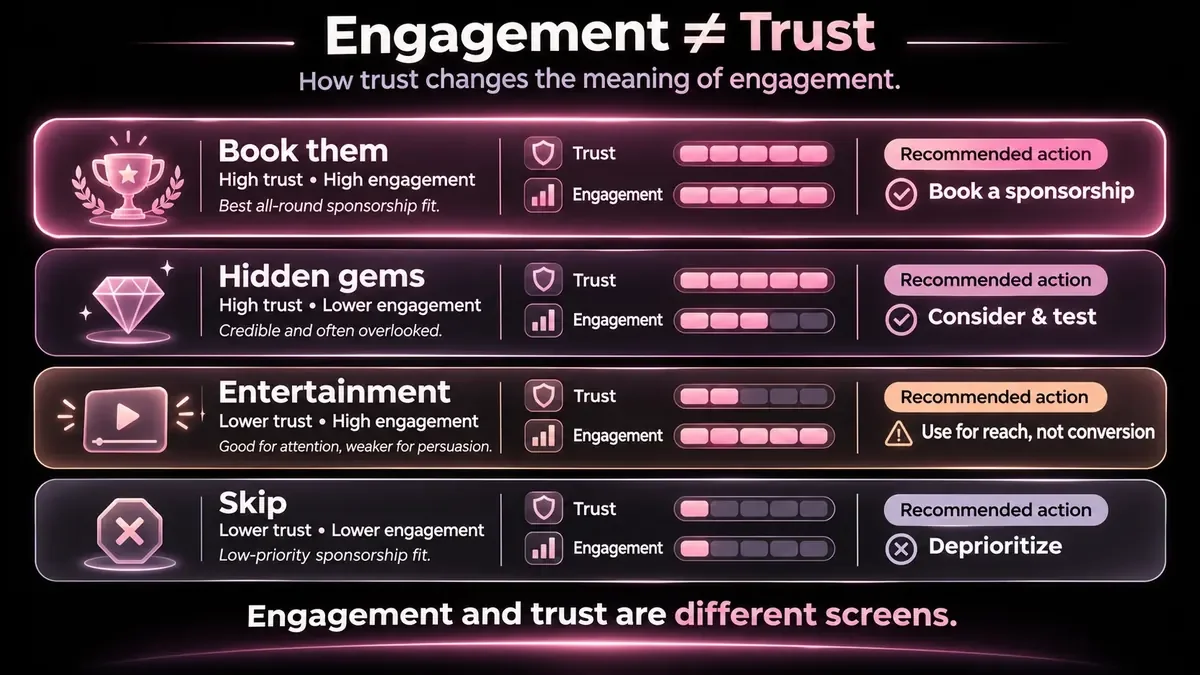
A simple way to think about it:
High trust + high engagement
Potentially an excellent sponsorship partner.
High trust + lower engagement
Could be an overlooked opportunity.
Low trust + high engagement
The audience may love watching, but that does not necessarily make the creator persuasive.
Low trust + low engagement
Usually a weak starting point.
Look at How the Creator Forms Opinions
Trust is difficult to reduce to one number.
You often need to actually examine the content.
Does the creator explain why they reached a conclusion?
Do they acknowledge weaknesses in products?
Do they compare alternatives?
Do they challenge claims instead of accepting everything at face value?
Do they appear selective about what they recommend?
A creator who occasionally says that a product is not good enough can sometimes make their positive recommendations more believable.
The objective is not to find someone who agrees with every brand talking point.
It is to find someone whose audience sees them as a credible source of information.
Look Beyond the Channel Category
Brands also make mistakes when they focus too heavily on category labels.
A cybersecurity company may immediately search for cybersecurity channels.
An AI company may only look at AI creators.
A productivity company may only search for productivity channels.
Those creators can absolutely be strong fits, but the obvious niche is not always the only opportunity.
A cybersecurity product could potentially fit a developer, business, technology or privacy-focused creator.
An AI tool could fit designers, programmers, entrepreneurs or researchers.
The better question is:
Does this creator have an audience that trusts them on decisions relevant to our product?
That opens up a much wider creator pool without abandoning relevance.
Watch the Content, Not Just the Dashboard
Creator databases are useful for discovering channels.
They are much less useful for understanding how somebody actually communicates.
This is where watching videos or reviewing transcripts becomes valuable.
A transcript can reveal whether a creator:
explains their reasoning
demonstrates real expertise
communicates clearly
discusses trade-offs
integrates sponsors naturally
repeatedly promotes unrelated products
sounds different during sponsored sections
Metrics can tell you what happened.
Content helps explain why the creator may be influential.
A Practical Creator Trust Check
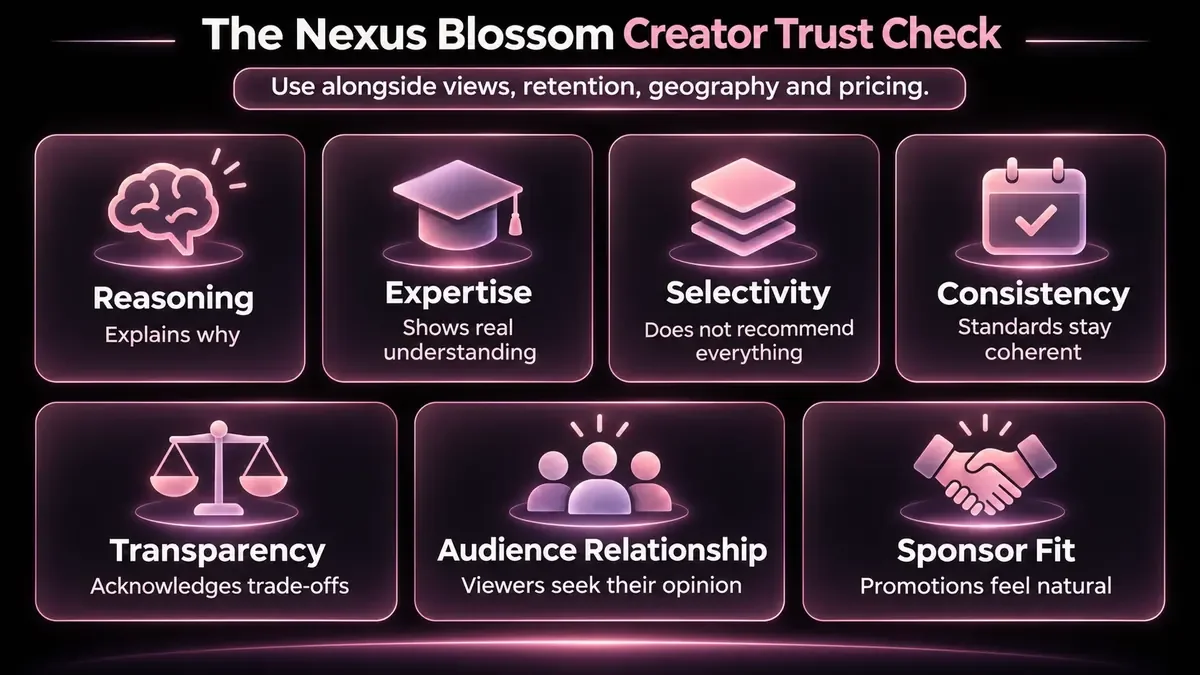
There is no perfect trust score, but brands can look for several signals.
Reasoning
Does the creator explain how they reached their conclusions?
Expertise
Do they demonstrate real understanding of the topics they discuss?
Selectivity
Does every product receive praise, or does the creator appear selective?
Consistency
Do their opinions and standards remain reasonably consistent across videos?
Transparency
Are limitations, alternatives and trade-offs acknowledged?
Audience relationship
Do viewers ask for advice and respond to the creator as someone whose opinion matters?
Sponsor fit
Does sponsored content feel connected to what the creator normally discusses?
None of these signals should replace analytics.
They should sit alongside views, Engaged Views, retention, geography, demographics and pricing.
A Smaller Trusted Creator Can Be the Better Buy
Imagine two creators.
Creator A averages 100,000 views but promotes a wide variety of unrelated sponsors and rarely explains why they recommend them.
Creator B averages 45,000 views, is highly selective about sponsorships and regularly explains how products fit into their own workflow.
Creator A gives the brand more reach.
Creator B may provide more credibility.
Which one is better depends on the campaign.
For pure awareness, Creator A could make sense.
For a product that requires explanation, trust and consideration, Creator B could potentially be the stronger partner.
This is why creator selection should rarely come down to one metric.
Trust Matters Even More for Tech Products
Trust becomes particularly important when the product requires the viewer to believe a claim.
Think about:
cybersecurity software
password managers
VPNs
AI tools
financial technology
developer tools
productivity software
expensive hardware
A viewer may need to trust that the creator genuinely understands the product before they are willing to try it.
A 2026 study found trustworthiness and information quality were among the strongest influencer attributes associated with online buying intentions in its sample.
That makes creator credibility especially important for brands selling products that require more consideration than a simple impulse purchase.
Metrics Still Matter
None of this means brands should ignore performance data.
You still need to know whether the creator reaches enough relevant people at a sensible price.
Look at:
average and median views
Engaged Views
audience geography
audience retention
demographics
historical performance
sponsorship frequency
CPM
asking price
Then add another question:
Would this audience actually trust this creator telling them about our product?
That extra question can change the shortlist completely.
How Nexus Blossom Evaluates Creator Fit
At Nexus Blossom, creator evaluation goes beyond subscriber count.
For tech and digital campaigns, we look at performance, audience relevance, content fit and how naturally a creator could communicate the product.
That can include reviewing recent videos and transcripts to understand how the creator actually speaks to their audience, not simply what category a database assigns to the channel.
The goal is not to find the biggest creator.
It is to find creators whose audience, credibility, content and pricing make sense together.
If your brand is planning a YouTube creator campaign, visit our Brands page or contact brands@nexusblossom.com.